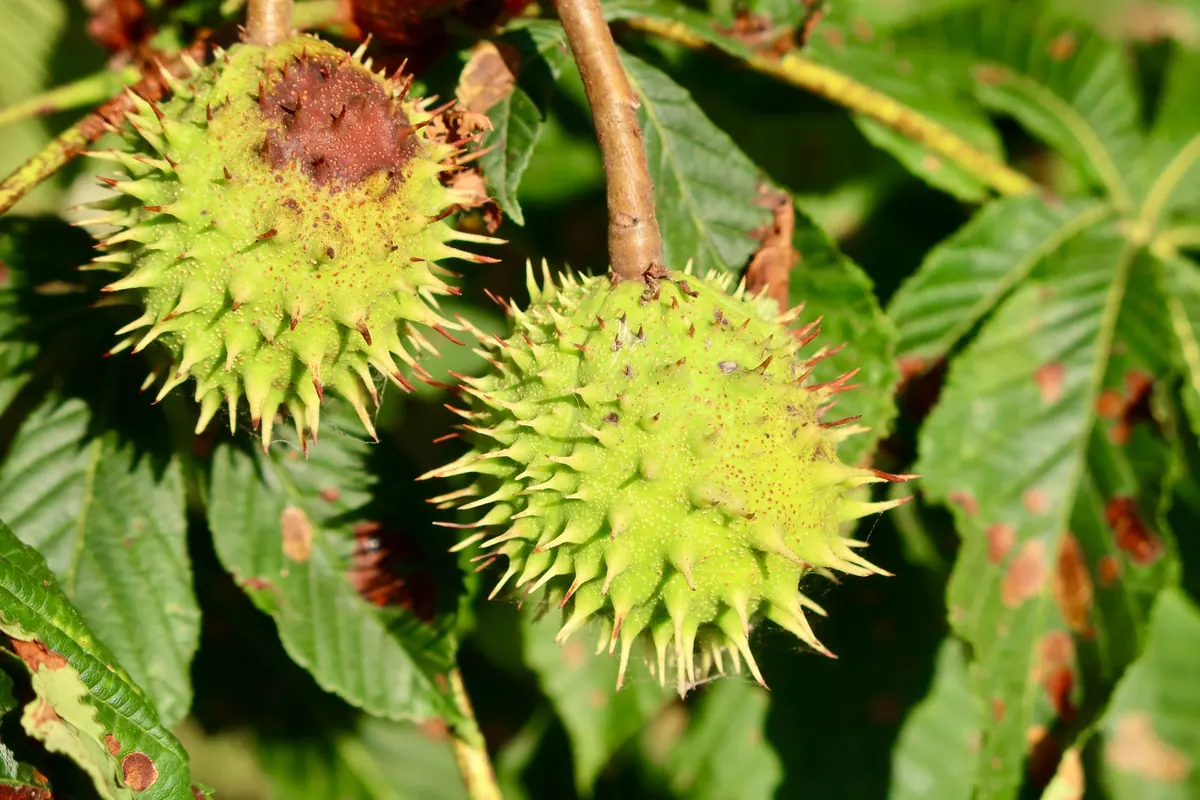
Most conker players learn to read the ground before they learn to read the tree. A fat, glossy conker in the grass is the whole story, as far as the game is concerned. But the ground tells you about the weather six weeks ago, and the tree tells you about the year it has had. Research into horse chestnut diseases has been quietly building a picture of a species under several pressures at once, and some of that work lands directly on the playground floor.
Horse chestnuts in Britain and much of Europe are dealing with more than one thing at a time. The research that matters most to players tends to group into three areas, because each one changes how much sugar the tree can put into its seed.
A small moth, Cameraria ohridella, lays eggs on horse chestnut leaves. Its caterpillars burrow inside the leaf and feed on the tissue between the upper and lower surfaces. The mines start as pale blotches and spread until whole leaves go brown and crisp in midsummer, weeks before they should. The moth arrived in Britain in the early 2000s and is now widespread across much of England and Wales. A tree can survive this comfortably for years, but it loses a large share of its growing season, and that shows up in the crop.
A fungus, Guignardia aesculi, causes brown patches with a yellow edge, usually from late July onwards. On its own it is often the mildest of the three, and it tends to arrive after the leaf miner has already done its damage. Together they strip a canopy fast.
Dark, sticky liquid weeping from patches on the trunk or branches is the signature. The most damaging form is bacterial, caused by Pseudomonas syringae pv. aesculi, and it can girdle a branch or, in bad cases, kill a tree. Not every bleed is the same problem: some is caused by Phytophthora, a fungus-like organism often linked to soil and root conditions. Both mean a tree spending energy on defence rather than on conkers.
The logic is arithmetic rather than mystery. A conker is stored food and a small embryo in a hard shell, and the tree funds it with the sugar it makes in its leaves. Lose the leaves in July or August and there is less in the account. Add an infection the tree is fighting and there is less still.
In practice, players notice this as a run of conkers that look right but feel wrong. They are smaller, lighter in the hand, and more likely to be hollow or shrivelled inside. Trees that defoliate early also tend to shed their crop sooner, and a conker that hits the ground before it has fully hardened is softer and duller. It may still be perfectly round. It just will not survive many hits.
It is worth remembering that horse chestnuts have good and bad years anyway, quite apart from disease. Heavy crops tend to be followed by lighter ones while the tree recovers. Disease adds noise to that cycle, which is why a bad conker autumn in your area does not automatically mean a bad one ten miles away.
Before you commit to a tree, spend a few minutes looking up rather than down.
If the disease research tells us anything practical, it is that the best conkers increasingly come from a shrinking set of trees. Look for mature trees with a decent canopy, plenty of air around them and no obvious bleeding. Trees in open parkland and along wide verges often cope better than crowded specimens in dry, compacted ground, where drought stress piles on top of everything else.
The other thing to plan for is timing. In a heavily mined area, the crop can drop early and fast, and the conkers that fall first are often the lightest. Get out within a day or two of a windy spell rather than waiting for the weekend, and be prepared to travel a bit further to find trees that kept their leaves.
One safety note for foragers: horse chestnuts are not edible. The conkers contain aescin and can make people and animals ill, and they are a different species from sweet chestnuts. If someone has eaten a quantity, take proper advice rather than waiting to see.
None of this means the game is in trouble. It means the reliable trees are worth knowing by name. Pick three or four local specimens, check them in high summer, and you will know by the end of August roughly what kind of autumn you are in for — whether it is worth drilling and threading your usual haul or setting your sights on a smaller, denser, harder-hitting set.
Keep a few spares from a good year somewhere cool and dry, away from damp and mice. Keep your laces fresh, your rules straight, and remember that some leagues ban baking, soaking and varnishing while others allow it, so check before you turn up with a suspiciously shiny champion. Then get out early, take the tree's side, and enjoy the ones you find.
Photo: Nikolai D / Pexels
A record-setting conker at this year's championship has players rethinking grip, stance and strike. Here is how the...
How a bitter, inedible seed from an ornamental tree became the centre of autumn playground life — and how children...
Conkers looks like a simple playground game, but its ancestry runs through Roman nut games and snail shells to the...

All the conker news, games, and lore..
